NeurIPS 2026
Beyond Bit Matching: Orthogonal Watermarks for Collusion-Resistant Image Fingerprinting
Zhakshylyk Nurlanov, Tobias Weißberg, Florian Bernard
University of Bonn and Lamarr Institute for Machine Learning and Artificial Intelligence
PaperarXivPDFCodePosterOpenReviewDeep diveBibTeXDemo: coming soon
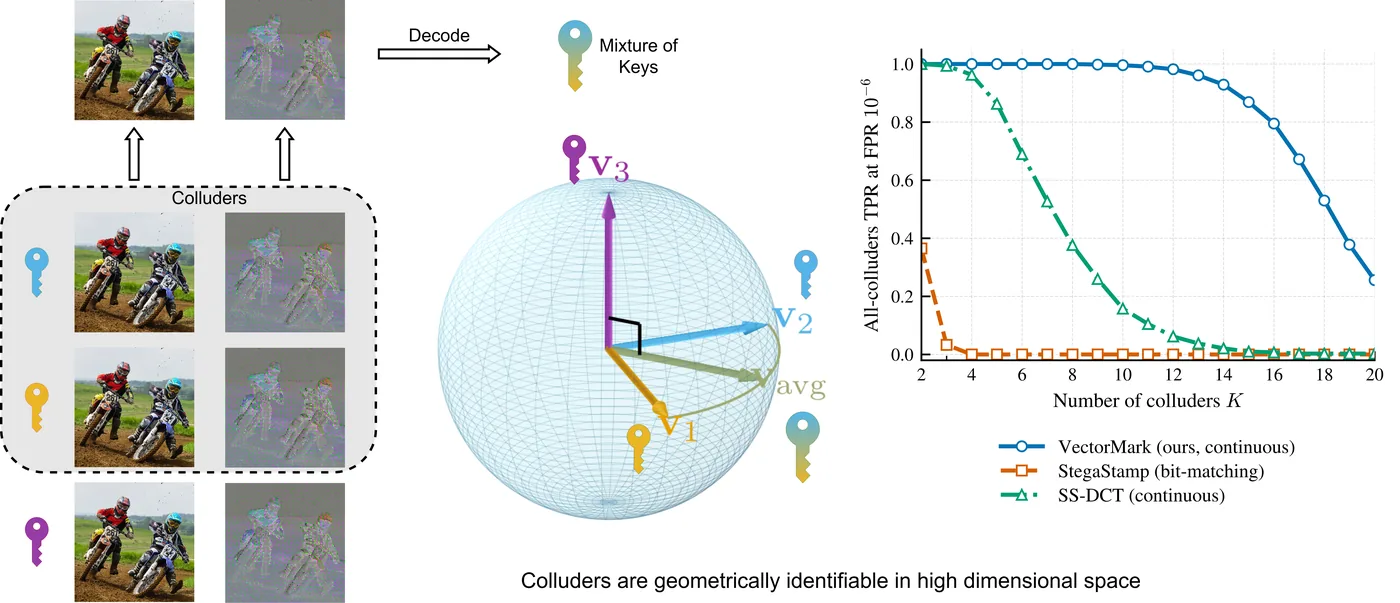
Ten colluders average their copies, and VectorMark still names all ten. Each user's copy carries an invisible key, a direction in a 1024-dimensional space, and the average of several copies still points toward every colluder.
98.0%
of trials find exactly the ten colluders among a million users
1.1%
of trials flag an innocent user (target: 1%)
40.3 dB
average PSNR of the watermarked images
Highlights
- User keys are near-orthogonal unit vectors. The normalized average of K colluders' keys keeps cosine 1/√K with each of them, while unrelated keys stay near zero.
- Detection thresholds come in closed form from a shifted Beta distribution, so the false-alarm rate is fixed in advance.
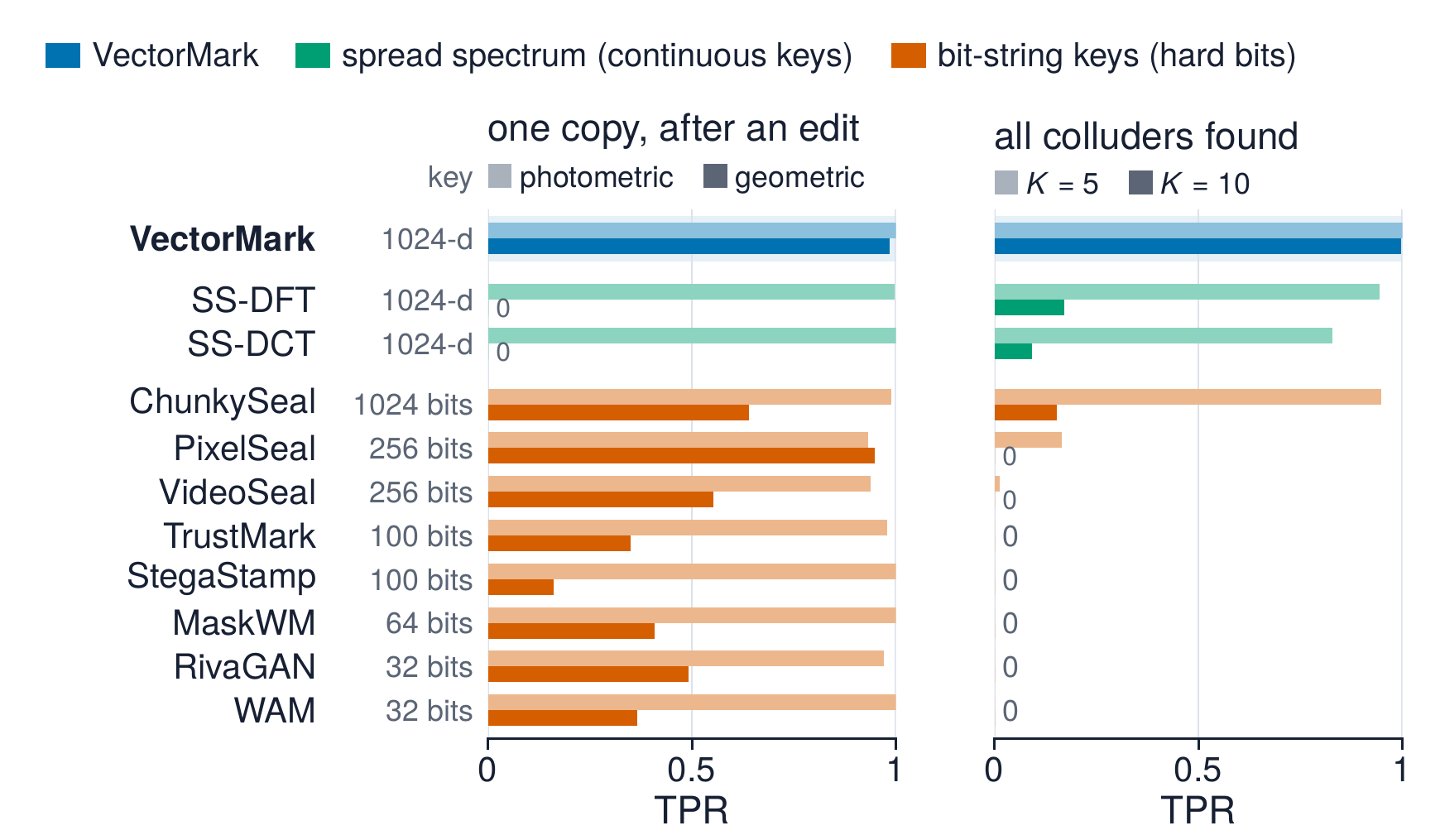
- Among eleven methods, the only one that is robust to geometric edits and keeps all colluders traceable after averaging.
- A collusion loss trains the encoder and extractor to treat averaged images like averaged keys.

Deep dive on the blog
How VectorMark traces ten colluders among a million users
The full walk through: what averaging does to bit-string IDs, keys as directions, thresholds, training, the comparison, registry size and attacks.
Abstract
Image fingerprinting assigns each distributed copy a user-specific watermark for source tracing. Averaging collusion is a central threat: several recipients can average their differently marked copies to suppress each individual mark. Discrete bit-string watermarks are especially vulnerable because averaging drives bit evidence toward ambiguous decisions. We introduce VectorMark, which maps user keys to near-orthogonal high-dimensional unit vectors and identifies colluders by cosine similarity to the extracted watermark direction. Under ideal averaging of K vector keys, the normalized average preserves a cosine signal of order 1/√K for each colluder, while unrelated keys remain concentrated near zero. The spherical geometry of random directions gives a shifted-Beta null distribution for cosine similarities, enabling analytic per-key false-positive-rate control after validation on unwatermarked images. VectorMark uses a neural watermark encoder and centered extractor trained with JND masking and a progressive curriculum for photometric, geometric, and collusion robustness. Experiments on MS-COCO, OpenImages, and AI-generated images show that VectorMark maintains robust watermark attribution under photometric and geometric distortions, and achieves the best strict all-colluder detection among evaluated methods, while preserving high visual quality.
Limitations and responsible use
The analysis assumes equal-weight averaging of near-orthogonal keys. Unequal weights, strong non-linear processing and scheme-aware removal reduce the margin, and calibration should be checked on the images where the method is deployed. A watermark score is statistical evidence, not proof that a person did something: the embedding service and key material must be protected, and attribution should be combined with independent records.
Poster
NeurIPS 2026, Sydney. Tuesday, December 8, 17:00–20:00, Hall 1–4, poster #S4119.

BibTeX
@inproceedings{nurlanov2026vectormark,
  title     = {Beyond Bit Matching: Orthogonal Watermarks for Collusion-Resistant Image Fingerprinting},
  author    = {Nurlanov, Zhakshylyk and Wei{\ss}berg, Tobias and Bernard, Florian},
  booktitle = {Advances in Neural Information Processing Systems},
  year      = {2026},
  url       = {https://openreview.net/forum?id=wwfGrsZBIz}
}This work is supported by the ERC Starting Grant no. 101160648.