How VectorMark traces ten colluders among a million users
Suppose you share a photo with a thousand people and want to know who leaked it if it shows up online. The classic answer is fingerprinting: every recipient gets a personal copy with an invisible watermark, an ID for that person. When a copy leaks, you read the ID and you know the source. Typical uses are licensed photos, press previews and confidential designs.
The weak spot is collusion. If several recipients get together and average their copies pixel by pixel, the image still looks clean, but each watermark is now several times weaker and mixed with the others. This post walks through how VectorMark, our NeurIPS 2026 paper with Tobias Weißberg and Florian Bernard, keeps every colluder traceable in that situation. The figures are the ones on our poster.
One real run
A registry has a million users, each with their own key. Ten of them receive marked copies of the same photo, average them and leak the result. The owner then scores every registered user against the leaked image.





With 100-bit IDs (TrustMark), none of the ten colluders reaches the detection threshold. With VectorMark’s 1024-dimensional keys, all ten are found and nobody else is flagged:


Top: matching bits with 100-bit IDs. Bottom: cosine scores with VectorMark. Pink: the ten colluders. Grey: the other 999,990 users. Dashed: the threshold for a 1% false-alarm budget over a million users.
What averaging does to bit-string IDs
Most image watermarks carry a string of bits. After averaging, each bit position holds a mix of the colluders’ bits, and the decoder rounds it back to a single ID, roughly the majority vote at every position. The small example below has five colluders with 10-bit IDs, in the worst case for the owner: every position is a 3–2 split.
With ten colluders and 100-bit IDs, the rounded string agrees with each colluder’s ID in about 62% of the bits. That sounds like a lot until you look at the threshold. Random IDs agree with any string in about half of the bits, and among a million registered users the luckiest innocent IDs reach about 73% by chance. To accuse anyone while keeping false alarms rare, you need about 78%. The colluders sit at 62%, inside the crowd of innocent users.
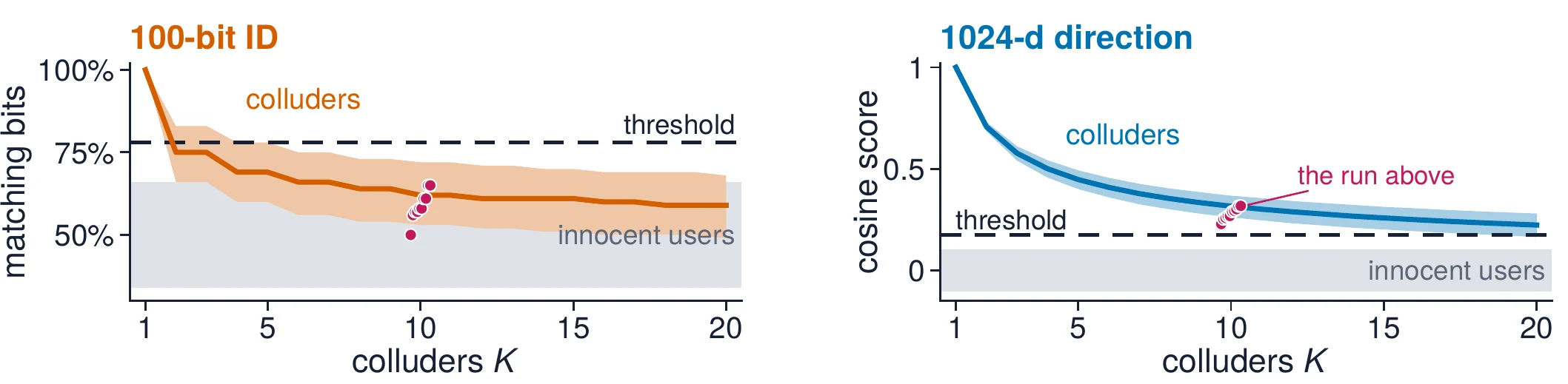
Each colluder’s score after ideal averaging, for a 100-bit ID (left) and a 1024-dimensional direction (right). Grey: innocent users. Dashed: the threshold for a million users at a 1% false-alarm budget. Pink dots: the run above.
Keys as directions
VectorMark turns each user ID into a direction: a unit vector in , built from a random linear code and a fixed rotation. In so many dimensions, two random directions are almost perpendicular. So if you add up the keys of colluders and scale the sum to length one, the result keeps the same cosine with each of them:
For ten colluders that is 0.32, while unrelated keys stay close to zero. The signal shrinks slowly, as one over the square root of the number of colluders, and the decoder keeps it as a soft score instead of rounding it away.
Thresholds you can compute in advance
A user is reported when their score passes a threshold , chosen so that an unrelated user passes it only with a small probability . With registered users and a 1% false-alarm budget in total, . For an image without a watermark, the cosine to any fixed key follows a known distribution, a shifted Beta, so the threshold has a closed form:
| key | α = 10−6per user | α = 10−81% over 106 users |
|---|---|---|
| 100-bit ID, matching bits | 74.0% | 78.0% |
| 256-bit ID, matching bits | 65.2% | 67.6% |
| 1024-bit ID, matching bits | 57.5% | 58.9% |
| 1024-d direction, cosine | 0.148 | 0.174 |
Bit counts follow a binomial distribution, cosines a shifted Beta. Longer IDs need a smaller share of matching bits, but after averaging, the rounded ID matches each colluder in barely more than half of them.
Training the encoder and extractor
The ideal picture only holds if the image model treats averaging of images like averaging of keys. VectorMark uses a U-Net encoder that hides the key in the image and a U-Net extractor that reads a direction back. A just-noticeable-difference mask keeps the watermark in textured areas, where it is hard to see, and training applies random photometric and geometric edits .



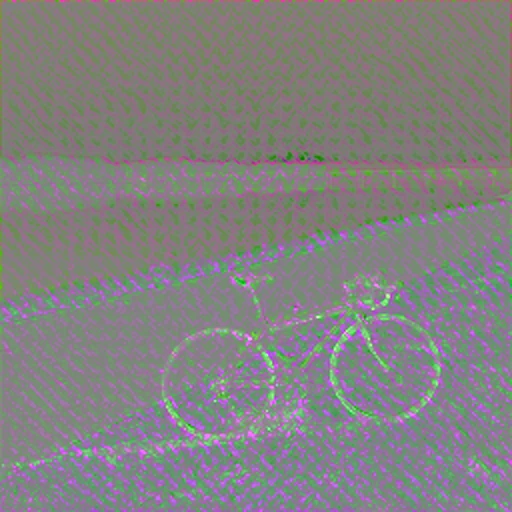


The score under each edited image is the cosine between the key read from that image and the user’s key; anything above 0.148 counts as found. The part that targets collusion is a loss on averaged copies. It asks that the average of marked copies looks like one copy marked with the averaged key, and that the extractor reads the averaged key from both, even after an edit:
Here is the average of the marked copies and is the average of their keys, scaled to length one.
Comparison with ten methods
We compared VectorMark with ten published methods on the same images and the same 45 edits, at a false-alarm rate of 10−6 per user. Bit-string methods are scored by matching hard bits and continuous keys by cosine; a collusion test passes only if all colluders are found. ChunkySeal, PixelSeal, VideoSeal and WAM were evaluated by us with the same protocol.
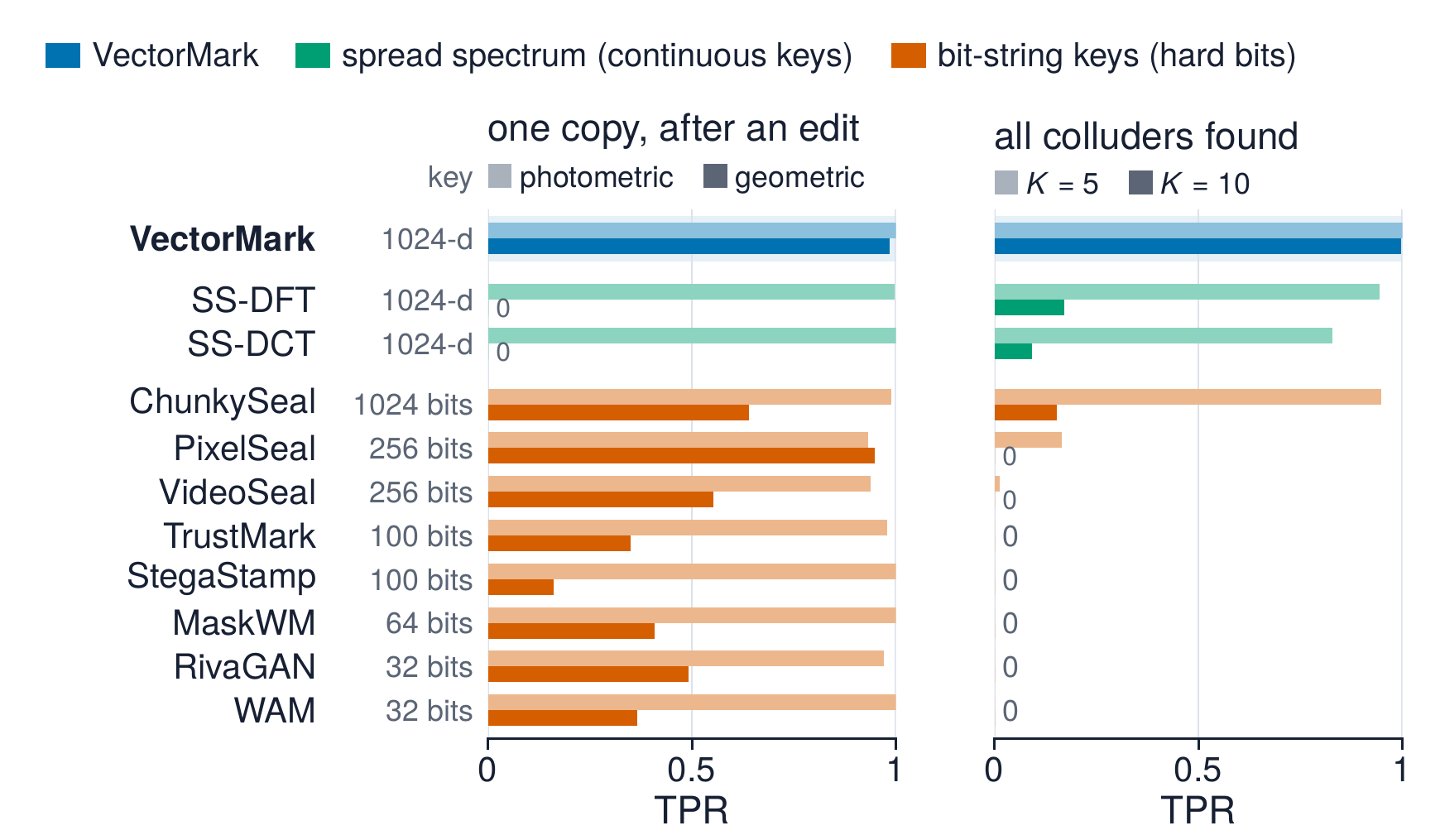
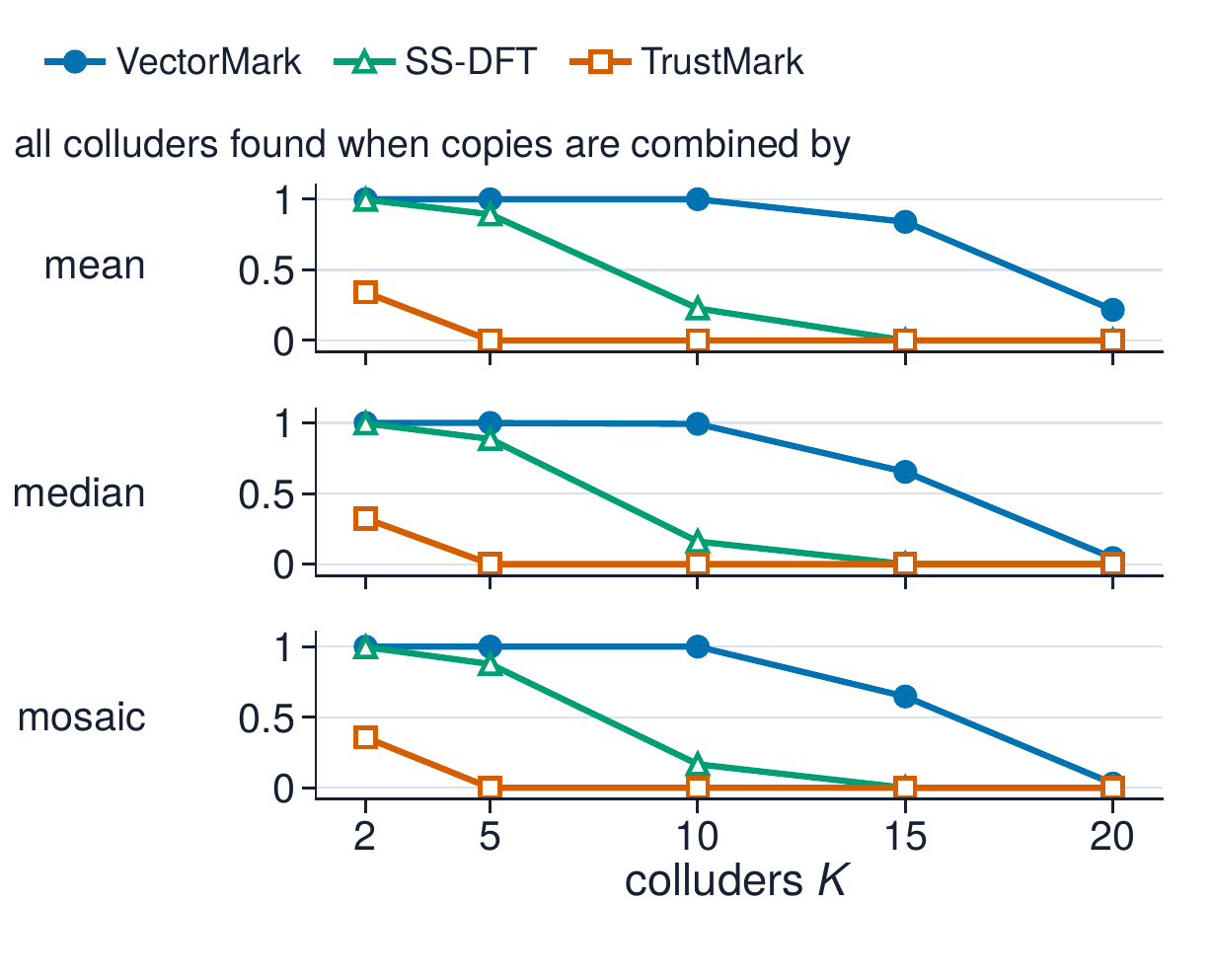
VectorMark is the only method that is both robust to geometric edits and keeps all colluders traceable. Spread-spectrum keys also survive averaging, but not rotation or cropping. Combining copies by median or mosaic, which training never used, reduces the margin at large group sizes.
Registry size, soft scores and key dimension
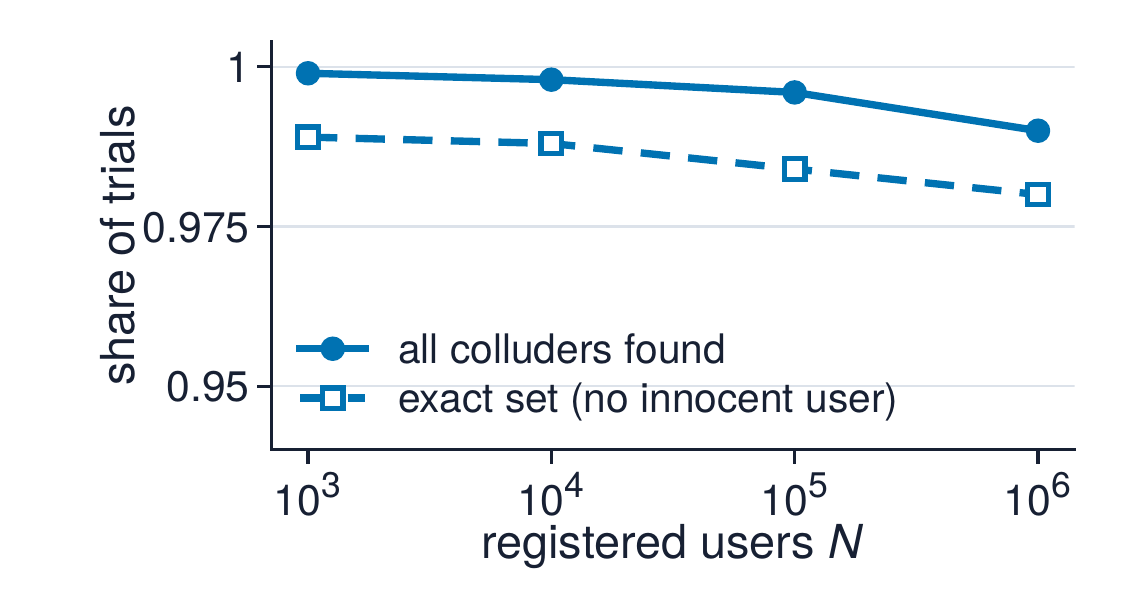
Scoring every registered user and reporting everyone above the threshold works from a thousand to a million users. With ten colluders and a million users, recall is .998 and precision .999; all ten are found in 99.0% of trials, exactly the right set in 98.0%, and an innocent user is flagged in 1.1%, close to the 1% budget.
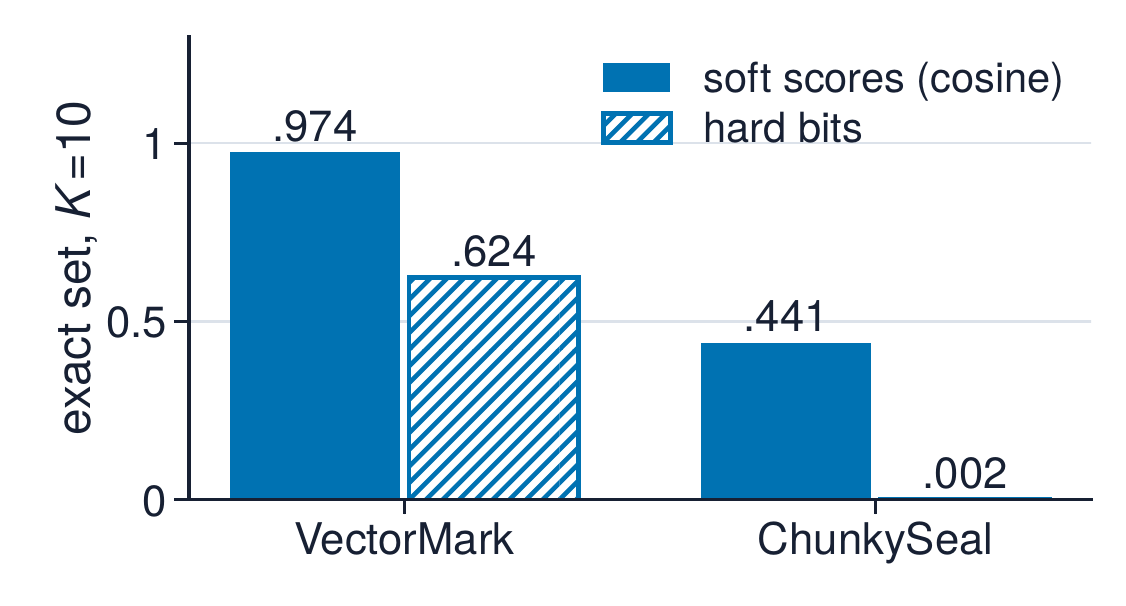
Two choices make this work, and both show up in the controls. The decoder keeps soft scores: on the same watermarked images, rounding the extracted vector to bits drops exact recovery of ten colluders from 97.4% to 62.4%. And the key has many dimensions: more dimensions give a lower threshold, so more colluders fit above it.
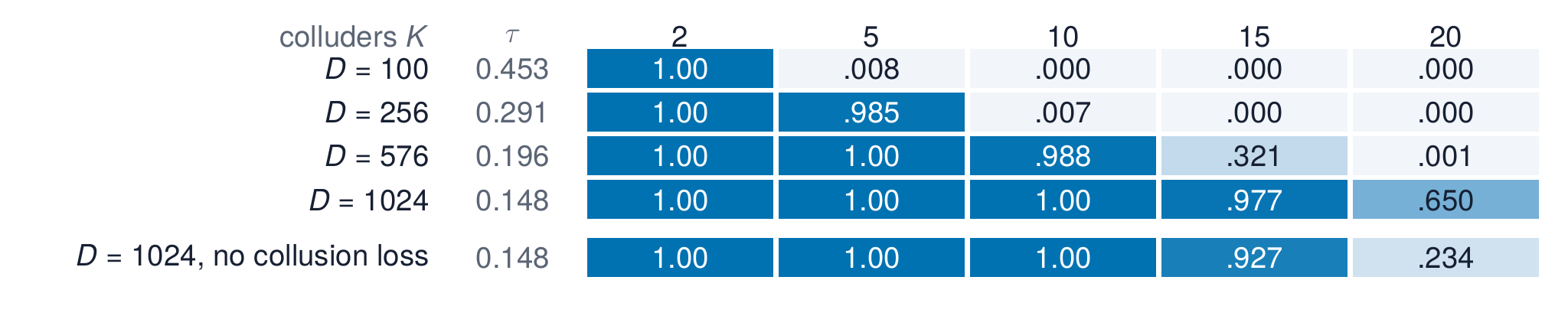
All colluders found at α = 10−6, by key dimension and group size. The collusion loss helps most at 15 to 20 colluders.
Attacks that try to remove the watermark
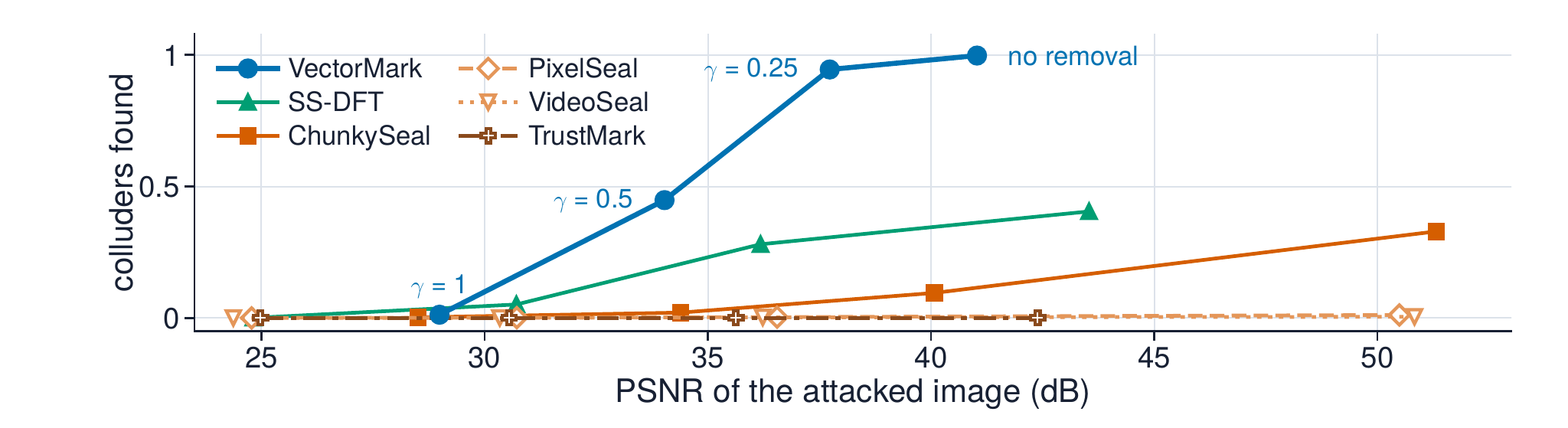
A scheme-aware attacker can estimate the watermark directions from the copies and subtract them, with a strength γ. We applied the same attack to every method. Over most of the range, VectorMark finds the most colluders at a given image quality. At γ = 0.25 it still finds 94.5% of them, with the attacked image at 37.7 dB; at full strength, γ = 1, the colluders are no longer found, and the image has dropped to 29 dB.
| Attack on VectorMark, 106 users | K | Exact set | Recall | Precision | PSNR |
|---|---|---|---|---|---|
| Averaging only | 10 | .979 | .998 | .999 | 41.03 |
| WmForger | 5 | .725 | .838 | .904 | 32.68 |
| Regen-VAE | 5 | .980 | .998 | .998 | 36.81 |
| SD1.5 img2img | 5 | .000 | .000 | .000 | 25.50 |
PSNR (dB) of the attacked image against the original. Diffusion regeneration can erase the watermark, together with much of the image quality.
Limitations and responsible use
The analysis assumes equal-weight averaging of near-orthogonal keys. Unequal weights, strong non-linear processing and scheme-aware removal reduce the margin, and calibration should be checked on the images where the method is deployed. A watermark score is statistical evidence, not proof that a person did something. Anyone with access to the encoder and a user’s key can embed that key, so the embedding service and the key material must be protected, and attribution should be combined with independent records.
The paper, code and poster are linked from the project page. If you are at NeurIPS 2026 in Sydney, come by poster #S4119 on Tuesday, December 8, 17:00–20:00, in Hall 1–4.