Course project, TU Munich 2020
3D Face Reconstruction and Retargeting from RGB-D
Nikita Korobov, Zhakshylyk Nurlanov, Sirin Fki dit Kaaniche, Hossameldien Abdalaleem
Technical University of Munich, course project in 3D Scanning and Motion Capture
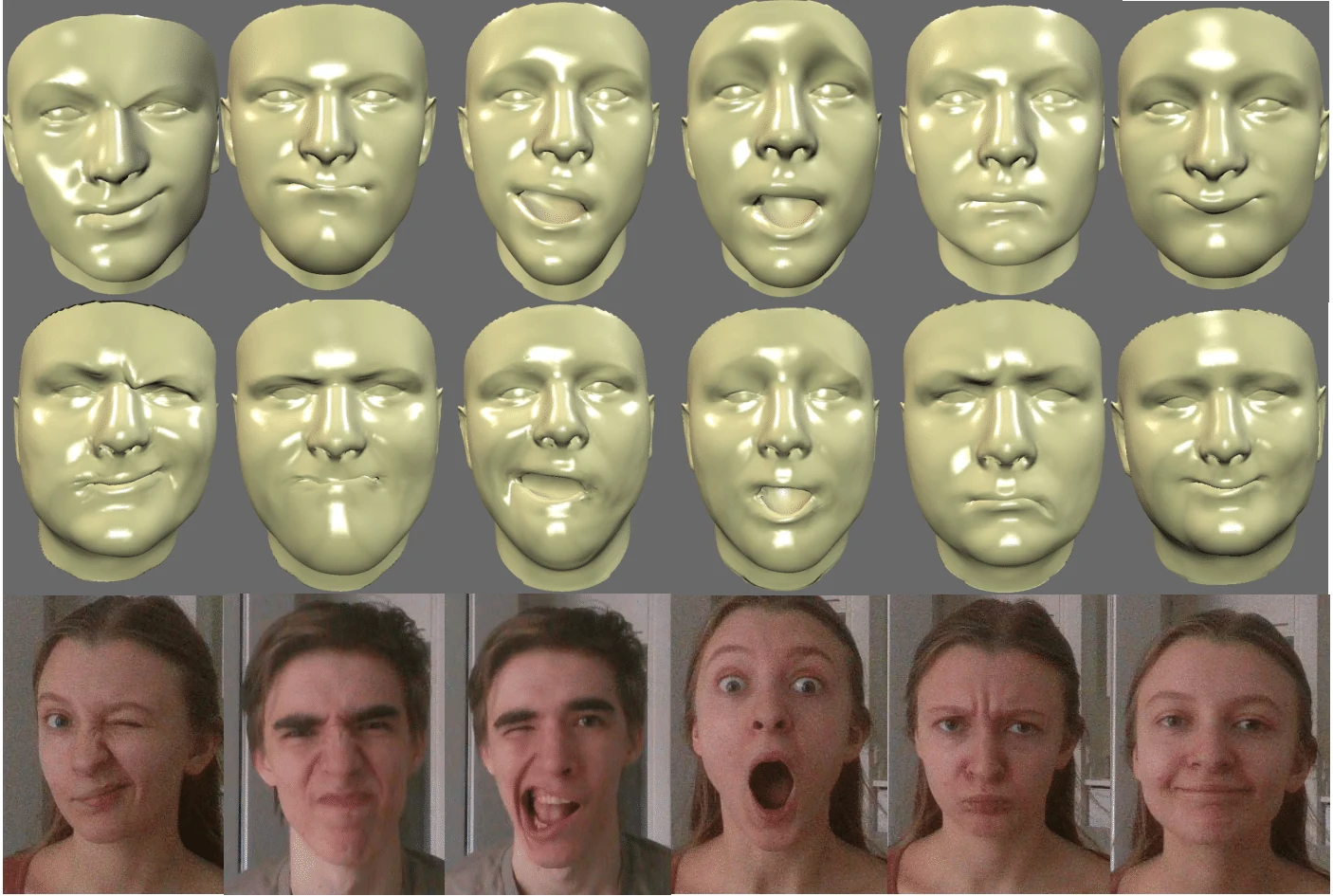
Reconstructs a face from an RGB-D video stream with a parametric face model and non-rigid ICP, and transfers the captured expression to another face mesh.
Highlights
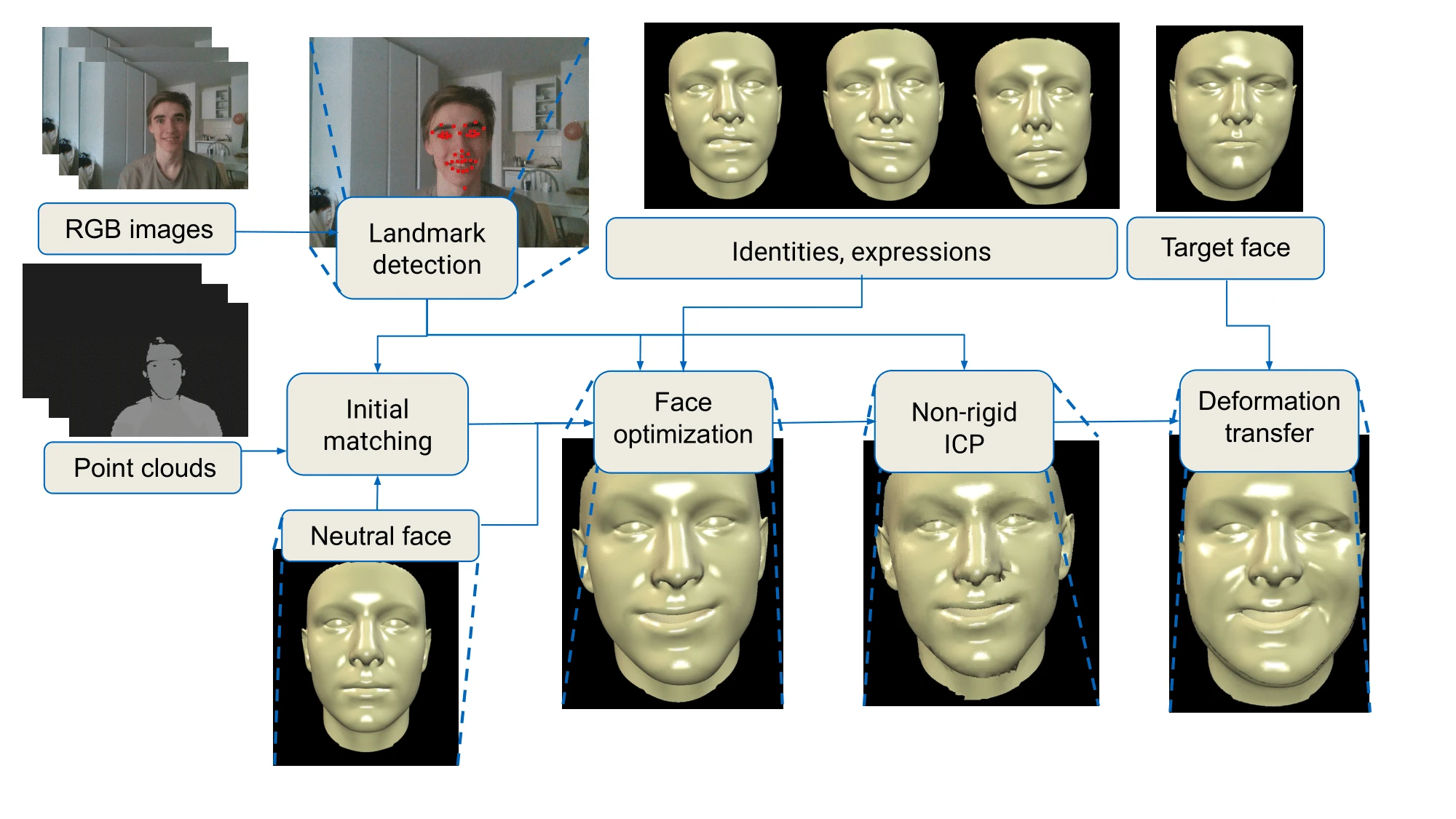
- Facial landmarks and a Procrustes alignment give the initial head pose.
- A parametric face model (identity and expression blendshapes) is fitted by non-linear least squares with Ceres.
- Non-rigid ICP refines the fit beyond the span of the blendshapes; deformation transfer moves the expression to a new face.
- Tested on a provided face scan and on our own RGB-D recordings.
Abstract
The aim of this project is the 3D reconstruction of human faces from an RGB-D video stream and the retargeting of the estimated facial expression to another mesh. For the initial model fit, facial landmarks are detected in the image and aligned with the corresponding landmarks of a neutral face using the Procrustes algorithm. The identity and expression of the face are then estimated by fitting a parametric face model with non-linear optimization, and the result is refined with non-rigid ICP. The obtained deformation is transferred to another face mesh using a few manually chosen correspondences. Experiments use a provided face scan as well as our own recorded RGB-D sequence.
Built in C++ with Eigen, Ceres, Sophus and dlib.