Technical report, TU Munich 2020
Fully Event-Based Visual Odometry
Zhakshylyk Nurlanov, Nikita Korobov
Technical University of Munich, course project in Vision-based Navigation
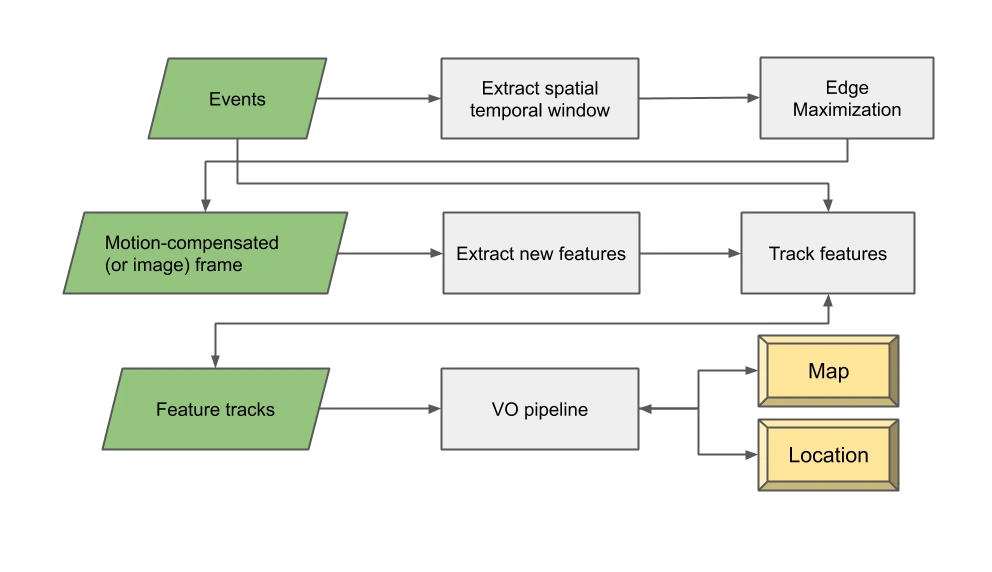
Visual odometry built only from event-camera data: event-based feature tracking, motion compensation with a new edge-maximization loss, and a monocular odometry pipeline on top.
Highlights
- An event-based feature tracker, a monocular visual odometry pipeline on feature tracks, and motion compensation of event images, each implemented from scratch in C++.
- Edge Maximization, a new loss for unsupervised motion compensation of events.
- Combined into one pipeline that estimates camera motion and a sparse map from events alone.
Abstract
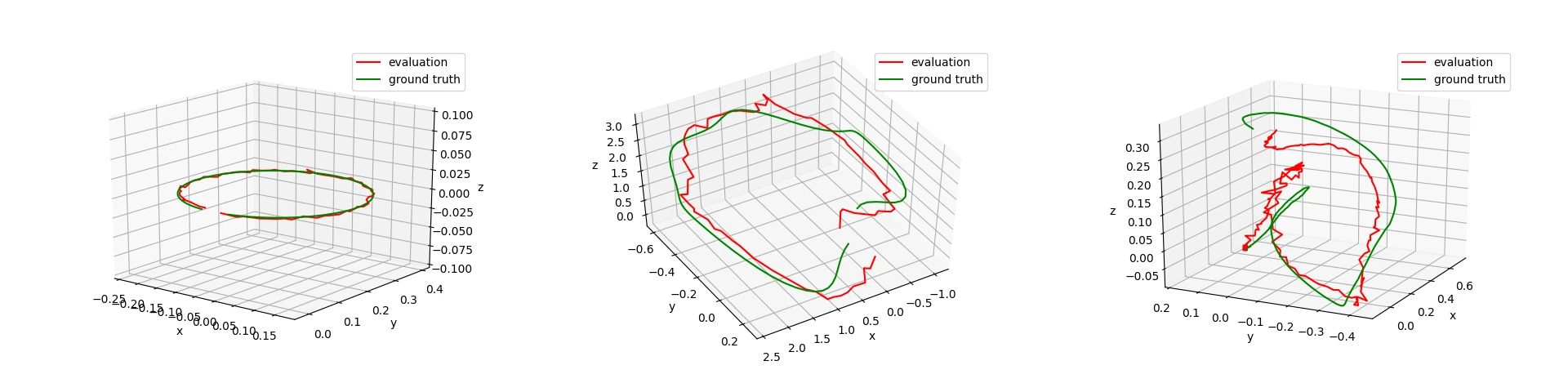
Event cameras are a new type of differential sensor that capture changes of contrast in each pixel asynchronously, with high dynamic range and under high-speed motion. In this work, we investigate the capability of event-based methods for visual odometry. We implement three independent algorithms: an event-based feature tracker, monocular visual odometry based on feature tracks, and motion compensation of event images. We also introduce a new loss function for unsupervised motion compensation, called Edge Maximization. Finally, we combine all the algorithms into a fully event-based visual odometry pipeline, and compare it with existing event-based visual odometry and tracking frameworks.
Nikita Korobov and Zhakshylyk Nurlanov contributed equally. Built with C++, Eigen, Ceres, OpenCV, Sophus and OpenGV.