ECML PKDD 2024, earlier version at the ICML 2023 AdvML-Frontiers workshop
Adaptive Certified Training: Towards Better Accuracy–Robustness Tradeoffs
Zhakshylyk Nurlanov, Frank R. Schmidt, Florian Bernard
University of Bonn and Bosch Center for Artificial Intelligence
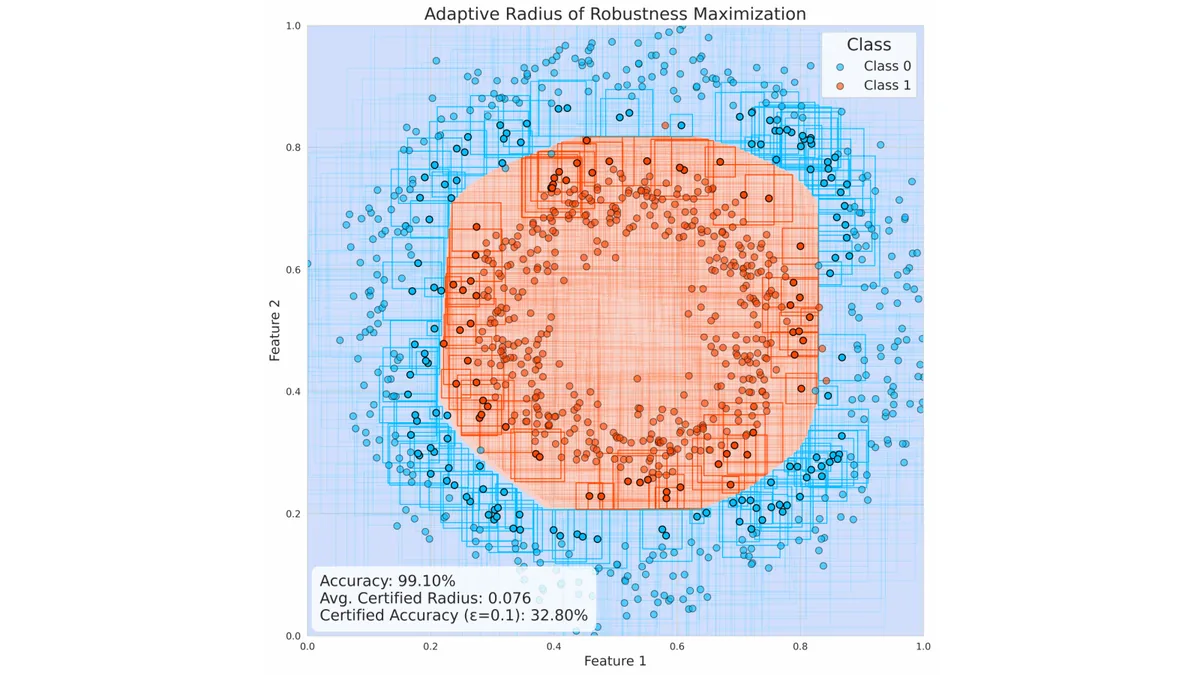
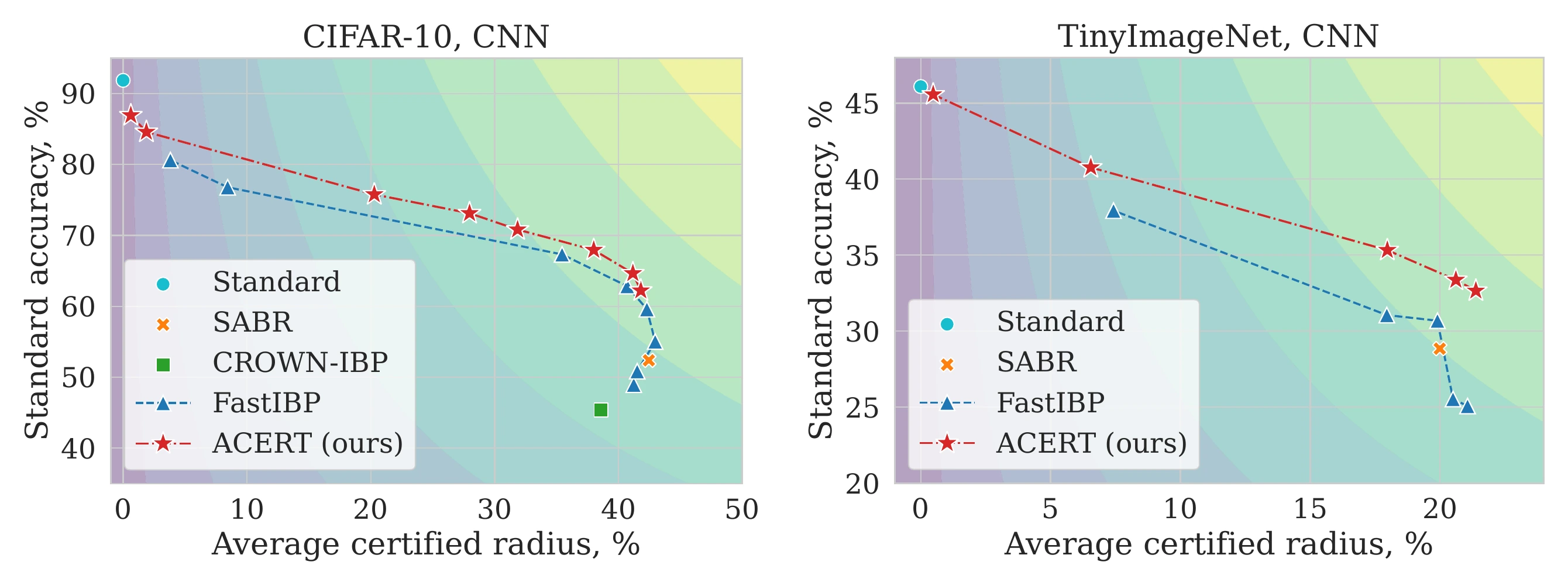
Certified training that adapts the certified radius to each training sample. At the same clean accuracy, it reaches up to twice the average certified radius of earlier methods on CIFAR-10 and Tiny ImageNet.
Highlights
- Each training sample gets its own certified radius, chosen adaptively during training.
- Up to twice the average certified radius of earlier certified training at the same clean accuracy, on CIFAR-10 and Tiny ImageNet.
- A whole accuracy–robustness curve from one knob, the share of the standard loss.
Abstract
As deep learning models continue to advance and are increasingly utilized in real-world systems, the issue of robustness remains a major challenge. Existing certified training methods produce models that achieve high provable robustness guarantees at certain perturbation levels. However, the main problem of such models is a dramatically low standard accuracy, i.e. accuracy on clean unperturbed data, that makes them impractical. In this work, we consider a more realistic perspective of maximizing the robustness of a model at certain levels of (high) standard accuracy. To this end, we propose a novel certified training method based on a key insight that training with adaptive certified radii helps to improve both the accuracy and robustness of the model, advancing state-of-the-art accuracy-robustness tradeoffs. We demonstrate the effectiveness of the proposed method on MNIST, CIFAR-10, and TinyImageNet datasets. Particularly, on CIFAR-10 and TinyImageNet, our method yields models with up to two times higher robustness, measured as an average certified radius of a test set, at the same levels of standard accuracy compared to baseline approaches.
BibTeX
@inproceedings{nurlanov2024adaptive,
  title     = {Adaptive Certified Training: Towards Better Accuracy-Robustness Tradeoffs},
  author    = {Nurlanov, Zhakshylyk and Schmidt, Frank R. and Bernard, Florian},
  booktitle = {Joint European Conference on Machine Learning and Knowledge Discovery in Databases (ECML PKDD)},
  year      = {2024}
}